Vocabulary taken from the “Convection summary” page. 361
Convection heat transfer coefficient
Phrase
The film coefficient, convection coefficient, or surface transmission coefficient, commonly represented as h, quantifies the influence of fluid, surface, and flow properties when convective heat transfer occurs.
Example: The convective heat transfer coefficient, h, can be defined as: The rate of heat transfer between a surface
es: Coeficiente de transferencia de calor por convección
Critical Reynold’s number
Phrase
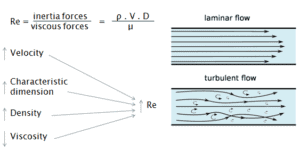
The Reynolds number is the ratio of inertial forces to viscous forces and is a convenient parameter to predict whether a flow condition will be laminar or turbulent.
Example: The critical Reynolds number is associated with the laminar-turbulent transition, in which a laminar flow becomes turbulent.
es: Número crítico de Reynold
Friction Coefficient
Phrase
The friction factor or Darcy-Weisbach coefficient of resistance (f) is a dimensionless parameter that is used in fluid dynamics to calculate the pressure drop in a pipe due to friction.
Example: The friction coefficients obtained increased with the concentration, which made it possible to obtain a potential relationship between said coefficient and the salt concentration for most of the fittings and pipes in which they were used.
es: Coeficiente de fricción
Kinematic viscosity
Phrase
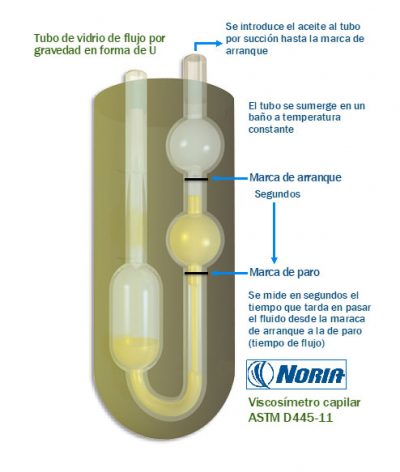
Kinematic viscosity is a measure of the internal resistance of a fluid to flow under gravitational forces.
Example: Viscosity can be measured and reported as dynamic (absolute) viscosity or as kinematic viscosity
es: Viscosidad cinemática
Laminar flow
Phrase
It is called laminar flows, the movement of a fluid when it is ordered, stratified and smooth.
Example: In laminar flow, the fluid moves in parallel sheets without intermingling and each fluid particle follows a smooth path, called a streamline.
es: Flujo laminar
Nusselt number
Phrase
The Nusselt number (Nu) is a dimensionless number that measures the increase in heat transfer from a surface through which a fluid flows (heat transfer by convection) compared to heat transfer if it occurred only by conduction.
Example: The Nusselt number is a quantity widely used to determine the heat transfer coefficient by convection.
es: Número de Nusselt
Prandtl number
Phrase
The Prandtl number is a dimensionless number proportional to the quotient between the diffusion rate of the moment quantity and the thermal diffusivity.
Example: In heat transfer problems the Prandtl number controls the relative thickness of the moment and thermal boundary layers.
es: Número de prandtl
Reynold number
Phrase
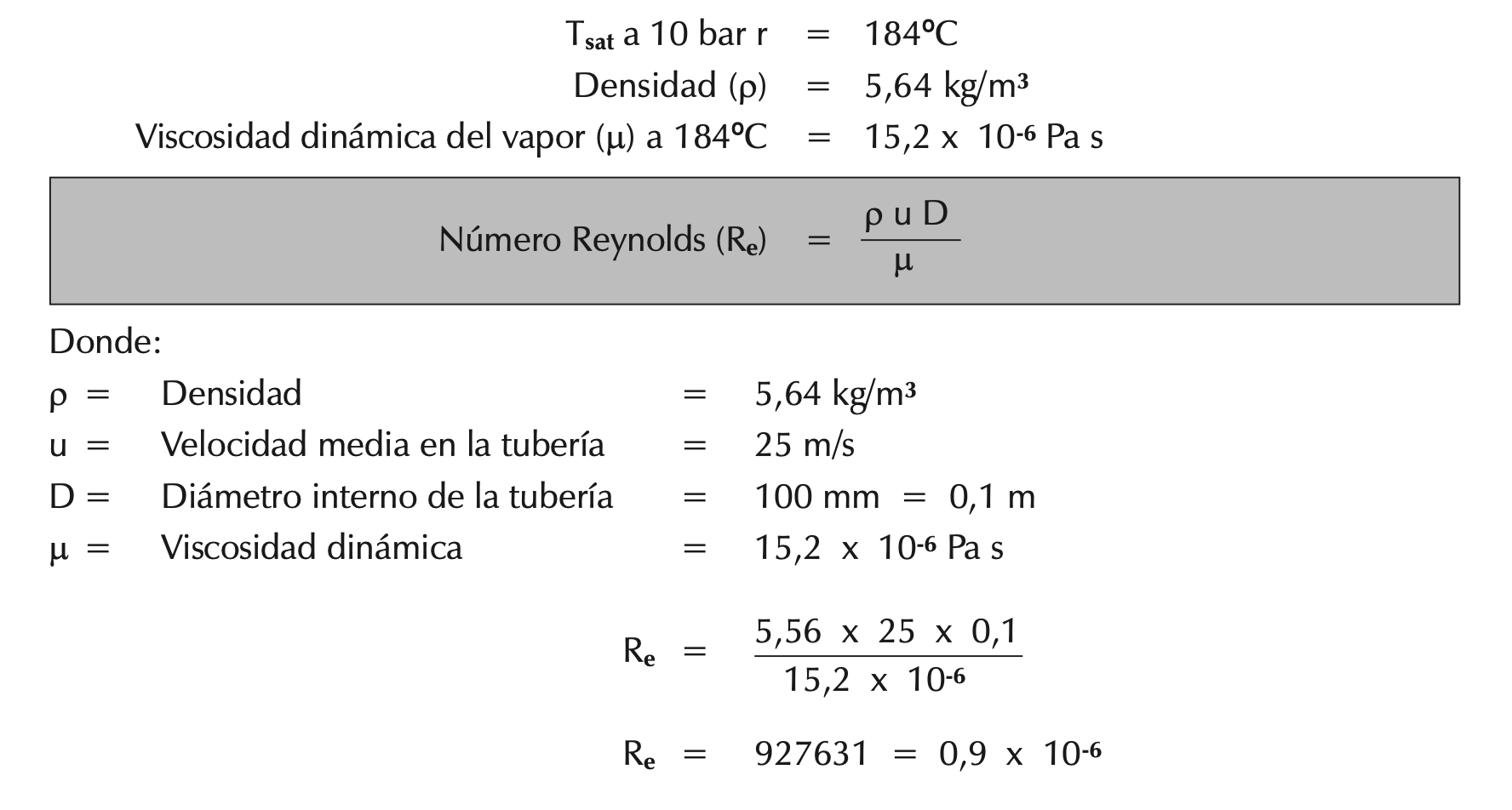
The Reynolds number is a dimensionless number used in fluid mechanics, reactor design, and transport phenomena to characterize the motion of a fluid.
Example: the flow with a Reynolds number around 100 000 (typical in the movement of a small aircraft, except in areas close to the boundary layer) expresses that the viscous forces are 100 000 times less than the convective forces, and therefore those they can be ignored.
es: Número de Reynold
Shear stress
Phrase
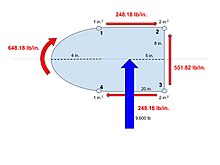
The term shear flow refers to a type of fluid flow which is caused by forces, not the forces themselves.
Example: Viscous fluids resist cutting motion. For a Newtonian fluid, the stress exerted by a fluid in shear resistance is proportional to the strain rate or shear rate.
es: Esfuerzo cortante
Turbulent flow
Phrase
Turbulent flow: it is one in which there are fluctuations in the flow all the time and the particles invade the path of the adjacent particles, mixing and moving in a random way
Example: The "turbulent" flow is characterized by the particles of the fluid do not move following defined trajectories